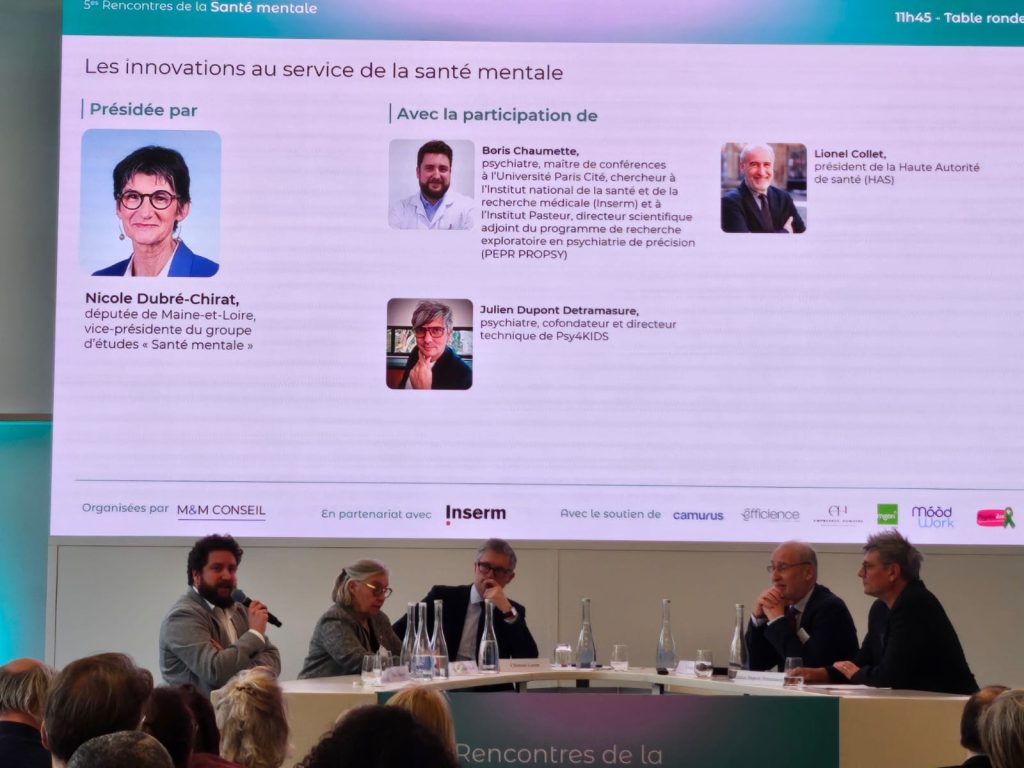
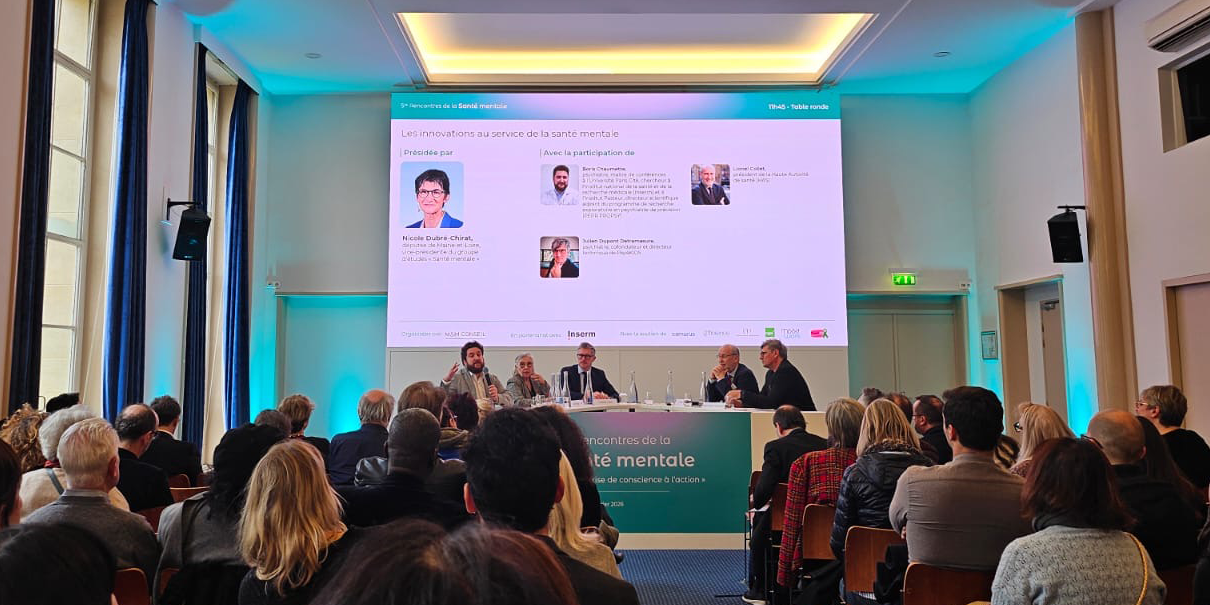
On February 18, 2026, the 5th Mental Health Conference, organized by the firm M&M Conseil in partnership with Inserm and chaired by Members of Parliament Nicole Dubré-Chirat, Chantal Jourdan, and Yannick Neuder, took place.
On this occasion, one observation became clear: psychiatry is at a decisive turning point in its history.
Faced with an exponential increase in needs, delays in diagnosis, fragmented care pathways, and underinvestment in research, the challenges related to structuring and cross-disciplinary collaboration are significant.
Solutions exist, as do technological and organizational innovations. They are already shaping the contours of tomorrow’s psychiatry.
Several key priorities have emerged:
-
Act earlier and closer to local communities: early detection, school-based prevention, local mental health contracts, post-hospitalization follow-up. The approach must become proactive rather than purely corrective.
-
Build coordinated, multidisciplinary responses: alliances between community care, hospitals, the medico-social sector, patients, associations, and civil society. Mental health is a collective issue that goes beyond institutional boundaries.
-
Accelerate the shift toward outpatient and local care: strengthen CMPs (Medical-Psychological Centers), develop home-based care, mobile teams, peer support, and graduated care pathways tailored to each situation.
-
Fully integrate mental health prevention: sleep, nutrition, daily rhythms, social factors… Taking care of the brain starts long before illness appears.
-
Invest heavily in research and innovation: biomarkers, genetics, neuromodulation, digital tools… The time has come for a refined approach to psychiatric disorders, based on understanding their etiology, to develop personalized care: moving toward precision psychiatry.
This is the ambition of PEPR PROPSY precision psychiatry research program, led by Inserm and CNRS, with support from the Fondation FondaMental.
Professor Boris Chaumette, deputy scientific director of the program, participated in the roundtable “Innovations in the Service of Mental Health.” On this occasion, he emphasized that “today’s research shapes tomorrow’s care.”
Nicole Dubré-Chirat called for better coordination of currently fragmented services. Despite multiple funding sources, the challenge remains to improve efficiency, strengthen research—which is still underfunded—and base decisions on solid scientific data, particularly regarding biomarkers and digital innovations.
MP Philippe Fait stressed the need for a graduated organization of care, ensuring coherent articulation between primary care, specialized services, and Expert Centers, to guarantee care pathways adapted to the severity and evolution of disorders.
The goal is clear: reconcile care and research to sustainably transform pathways and improve patients’ lives.